In various industries, especially manufacturing, automotive, and packaging, the coefficient of friction plays a crucial role in determining how materials will interact with each other. From ensuring smooth movement in machinery to preventing slippage in products, understanding the coefficient of friction (COF) is vital. This blog will dive into what COF is, the difference between static and kinetic friction, and the significance of coefficient of friction testers in measuring this property.
What is the Coefficient of Friction?
The coefficient of friction is a value that represents the amount of frictional force that resists the motion of two objects sliding against each other. It’s a dimensionless number that is essential in many engineering, manufacturing, and industrial applications. COF depends on the materials in contact, the smoothness of the surfaces, and external factors such as temperature and humidity.
The coefficient of friction can be classified into two main types: static friction and kinetic (or dynamic) friction.
- Coefficient of Static Friction: This refers to the frictional force that resists the initiation of motion between two objects. It is typically higher than kinetic friction because the force needed to overcome the initial resistance is greater than the force required to keep objects in motion once they start moving.
- Coefficient of Kinetic Friction: This refers to the friction between two objects that are already in motion relative to each other. The value of kinetic friction is generally lower than static friction and represents the ongoing resistance faced during relative motion.
Understanding these coefficients is essential for predicting the behavior of materials in real-world applications like sliding, rolling, and pressing.
Why is the Coefficient of Friction Important?
The coefficient of friction is a critical factor in designing various products and systems. Here’s why it matters:
- Safety and Stability: In the automotive industry, understanding the friction between tires and the road ensures better traction, preventing accidents and increasing vehicle stability.
- Material Performance: The performance of materials, especially in moving parts, depends on how well they interact with surfaces they contact. Too much friction can lead to wear and tear, while too little can cause slippage.
- Packaging Industry: In packaging, the coefficient of friction between materials like plastic films, cardboard, and paper can affect their handling, transport, and sealing quality.
- Efficiency: Reducing unnecessary friction in machinery and parts can help improve energy efficiency, reducing wear and tear, and extending the lifespan of components.
- Product Quality: In industries like textiles and printing, friction affects the quality of materials produced, such as the appearance of printed surfaces or the durability of fabric.
Coefficient of Friction Testers: How Do They Work?
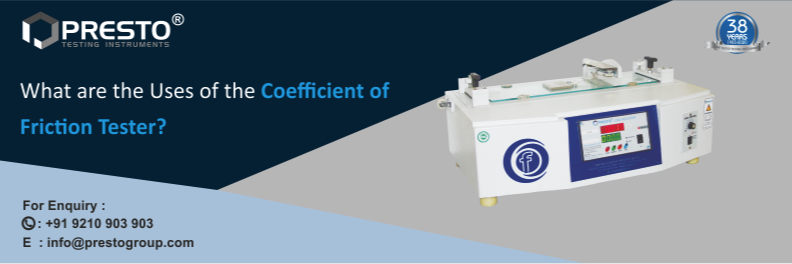
A coefficient of friction tester is a device that measures the frictional force between two materials and calculates their coefficient of friction. These testers typically consist of a movable sled or sample that slides over the test material under controlled conditions. The force required to move the sample is measured and used to calculate the coefficient of friction.
There are various methods for testing COF, with the two most common being:
- Horizontal Plane Test: In this method, a flat sample is placed on a horizontal plane, and the force needed to initiate or maintain movement is measured.
- Rotational or Circular Test: In this method, a rotating drum or cylinder moves the test sample, and the frictional force is calculated based on the amount of resistance encountered during rotation.
These tests can measure both static friction (when an object is at rest) and kinetic friction (when an object is in motion), providing a complete picture of the material’s behavior under different conditions.
Types of Coefficient of Friction Testers
There are various types of coefficient of friction testers, each designed for specific applications. Some of the common types include:
- Basic Manual Friction Testers: These are often used for smaller-scale applications and require manual operation for testing friction between materials.
- Digital Coefficient of Friction Testers: These automated testers provide digital readings and more precise measurements, often with built-in data recording and analysis capabilities.
- High-Speed Friction Testers: These are designed for materials that are subject to rapid motion, such as those used in the automotive and aerospace industries.
- Coefficient of Static Friction Testers: These testers measure the friction that resists the initiation of motion between two surfaces.
- Cyclic Coefficient of Friction Testers: These are used for materials that undergo repeated motion and allow for the measurement of friction under cyclical loading conditions.
Coefficient of Friction Tester Price: What to Expect
The price of a coefficient of friction tester can vary widely depending on several factors:
- Type of Tester: Basic, manual testers are typically more affordable, ranging from $100 to $500. Digital testers or high-precision models with additional features may cost anywhere between $1,000 and $10,000 or more.
- Features and Accuracy: Testers with advanced features, such as automated measurement systems, high-speed testing, and digital data recording, tend to be more expensive.
- Brand and Manufacturer: Established brands and manufacturers offering high-quality equipment may charge a premium, but the investment is often worthwhile for industries requiring reliable and precise measurements.
- Testing Standards: Some friction testers are designed to meet specific international standards (e.g., ASTM, ISO), which can influence their price.
When considering a coefficient of friction tester, it’s essential to balance cost with the specific needs of your testing application, accuracy requirements, and the volume of tests you plan to conduct.
Conclusion
Understanding and accurately measuring the coefficient of friction is critical for ensuring the performance and reliability of materials in numerous industries. Whether you are working with coefficient of static friction, evaluating materials for wear resistance, or testing packaging materials, having a coefficient of friction tester is essential. The right tester provides reliable data to enhance material performance, improve safety, and optimize efficiency.
When selecting a tester, it’s essential to consider the type of testing needed, the accuracy required, and your budget. With the right equipment, you can ensure that your materials are suited for their intended applications, improving the overall quality and longevity of your products.