In an era where deepfakes, synthetic identities, and sophisticated credential stuffing attacks are no longer the stuff of science fiction, “standard” identity security is rapidly becoming obsolete. For organizations operating in high-consequence sectors—such as federal agencies, defense contractors, and critical infrastructure—the baseline must shift. This shift culminates in NIST IAL3 verification, the highest tier of identity assurance defined by the National Institute of Standards and Technology.
While many businesses feel secure with Identity Assurance Level 2 (IAL2), the reality is that IAL2 is increasingly vulnerable to AI-driven spoofing. To achieve absolute certainty, organizations are now transitioning to an IAL3 compliant solution that anchors digital identities in physical reality and cryptographic proof.
What is NIST 800-63A IAL3?
The National Institute of Standards and Technology Special Publication 800-63A provides a technical framework for identity enrollment and proofing. Within this framework, NIST 800-63A IAL3 is reserved for high-risk scenarios where the consequences of a compromised identity are severe.
To reach IAL3, the verification process must satisfy several non-negotiable criteria that go far beyond a simple selfie and a driver’s license scan:
· Supervised Proofing: Verification must occur in the physical presence of an authorized representative or via a highly controlled, supervised remote session.
· Superior Evidence Standards: Applicants must present at least two pieces of “Superior” or “Strong” evidence (e.g., a biometric US Passport or a federal PIV card).
· Mandatory Biometrics: IAL3 requires high-resolution biometric collection (typically facial or fingerprint) to bind the physical person to their digital attributes.
· The Trusted Path: Crucially, the hardware used to capture this data must be secured and managed, ensuring that the sensor data hasn’t been tampered with or replaced by a virtual camera injection.
The Logistical Crisis of Traditional IAL3 Identity Proofing
Historically, the biggest barrier to IAL3 identity proofing was the “Retail Kiosk” requirement. Agencies were forced to send employees to specific physical enrollment centers—often post offices or government facilities—to have their identities verified by a live agent.
For a modern, distributed workforce, this legacy model is a failure:
1. High Overhead: Travel costs, lost productivity, and per-appointment fees can cost organizations hundreds of dollars per hire.
2. Geographic Inequity: Remote employees in rural areas may live hundreds of miles from a certified kiosk, creating hiring delays and frustration.
3. Auditing Fragility: Relying on third-party retail staff introduces human error and creates fragmented audit trails that struggle to pass FedRAMP High or DoD IL5 assessments.
Trust Swiftly: A Modern IAL3 Compliant Solution
Trust Swiftly has revolutionized the high-assurance landscape by decoupling IAL3 from the requirement of a physical retail store. By combining secure hardware logistics with advanced biometric software, Trust Swiftly provides an IAL3 compliant solution that brings the enrollment center to the user.
1. IAL3 Remote Kits: Security Delivered
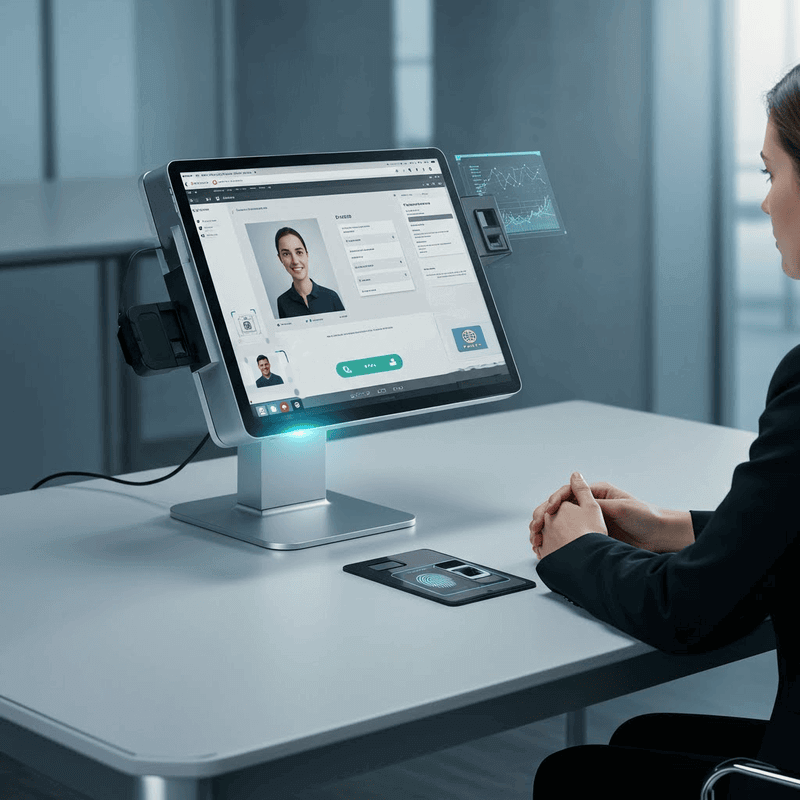
To support the remote-first economy, Trust Swiftly ships specialized, tamper-evident hardware kits directly to the user’s doorstep. These kits establish the “Trusted Path” required by NIST. Because the user does not have administrative access to the OS or the camera sensors, the possibility of a “Virtual Camera” attack—the primary method for deepfake injection—is eliminated.
2. Supervised Remote Identity Proofing (SRIP)
During the verification session, a trained Trust Swiftly operator (or your own authorized staff) supervises the process via high-definition video. This oversight ensures that the applicant is acting under their own volition, that no coaching is occurring, and that the biometric capture is real-time and authentic.
3. Cryptographic NFC Validation
Trust Swiftly leverages the NFC chips embedded in modern biometric passports. By cryptographically reading the chip, the system extracts the government-signed source photo and digital attributes directly from the document. This bypasses the vulnerabilities of OCR (Optical Character Recognition) and ensures that the evidence is genuine, valid, and accurate.
Why “Hardware-Anchored” is the Future of Zero Trust
As organizations transition to Zero Trust architectures, the “Identity” pillar must be the strongest. Software-only tools that run on an uncontrolled personal device (BYOD) can never truly reach IAL3 because the underlying operating system cannot be trusted.
By using an IAL3 compliant solution with managed hardware, you achieve:
· Sensor Integrity: You know the biometric data came from a real camera, not a software loop.
· Isolation: The verification environment is air-gapped from the user’s malware-prone personal devices.
· Immutable Audits: Every step of the IAL3 lifecycle is logged in a centralized, cryptographically signed trail, ready for 3PAO (Third-Party Assessment Organization) review.
Securing the Perimeter of the Person
NIST IAL3 verification is no longer just a niche requirement for the Department of Defense; it is becoming the necessary shield for any enterprise protecting high-value assets. Trust Swiftly makes this gold standard accessible, scalable, and cost-effective. By replacing the travel-heavy retail model with managed hardware kits and on-premise kiosks, you can secure your most sensitive perimeters without sacrificing operational speed.