
1. Overview of Malaysia

Malaysia is located in Southeast Asia, with a total area of approximately 330,000 square kilometers and a coastline stretching 4,192 kilometers. Situated near the equator, Malaysia experiences a tropical rainforest climate and a tropical monsoon climate, characterized by high temperatures and abundant rainfall throughout the year, with no distinct four seasons.
As of 2024, the population is 34.2 million, with a per capita GDP of about $11,649. According to World Bank standards, Malaysia is classified as an upper-middle-income country. It is a multi-ethnic and multicultural nation, with Islam as its official religion.
The country is rich in natural resources, ranking among the world’s top producers and exporters of rubber, palm oil, and pepper. It also has abundant petroleum reserves, along with minerals such as iron, gold, tungsten, coal, bauxite, and manganese. Malaysia is known for its production of tropical hardwoods. In its pristine forests, rare and endangered wildlife can be found, including flying lemurs, long-limbed and brown-furred giant apes, white rhinoceroses, and orangutans. The country is also home to a vast variety of birds, snakes, crocodiles, insects, and other wild animals. Orchids, giant apes, and butterflies are celebrated as the “Three Treasures” of Malaysia.

2. Overview of Malaysian Steel

Between 2013 and 2016, due to factors such as the dumping of cheap steel, Malaysia’s annual crude steel production once dropped to a relatively low level of 3 to 4 million tons. However, since 2016, its crude steel output has bottomed out and begun to rebound, showing strong signs of recovery.
According to the 2024 crude steel production data released by the World Steel Association, Malaysia’s crude steel production in 2023 was approximately 7.5 million tons, and in 2024 it reached about 8.8 million tons. This ranks third in ASEAN and around 20th in the world, representing a growth of 214% compared to 2015.
Malaysia is one of the important steel-producing countries in Southeast Asia, with its steel industry continuously expanding in scale and its output value steadily increasing. Currently, Malaysia’s steel industry is mainly concentrated in Peninsular Malaysia (West Malaysia), particularly in areas such as Kuala Lumpur, Selangor, Penang, and Malacca, where steel mills are relatively densely located.
According to the Southeast Asia Iron and Steel Institute, Malaysia currently has a steel production capacity of 16.1 million tons. Although there are numerous steel mills, their scales are generally not large.
In recent years, Chinese enterprises such as Jianlong Steel and Wenan Steel have invested in Malaysia, and many new blast furnace-based production capacities have been completed locally. According to estimates by the Southeast Asia Iron and Steel Institute, the country’s additional crude steel production capacity is expected to exceed 20 million tons by 2025.

3. Major steel companies in Malaysia

According to data from the Southeast Asia Iron and Steel Association, although Malaysia has a large number of steel mills, their scales are generally small. Apart from ten relatively large steel mills, the rest are small and medium-sized enterprises. Major steel companies include Lion Group, Ann Joo Steel Mills, China Steel Malaysia, Southern Steel Berhad, and Eastern Steel Malaysia, among others.

(1) ​​The Lion Group 
The Lion Group’s assets include two steel mills in Malaysia with an annual production capacity of 3 million tons, primarily manufacturing construction steel, wire rods, rebar, and other products. In 1978, the group obtained its operating license and became Malaysia’s largest steel producer. By 1985, after further expansion, its annual steel output exceeded 850,000 tons, solidifying its leading position in Malaysia’s steel industry. To date, The Lion Group’s steel mills account for over 60% of Malaysia’s total national steel production.
(2) ​​Malaysia Steel Works 
Established in 1971, Malaysia Steel Works is one of Malaysia’s largest steel mills and also one of the most important steel producers in Southeast Asia. The company mainly produces rebar, steel plates, steel pipes, as well as high-strength steel bars, low-carbon steel bars, and high-quality steel billets used in construction and infrastructure projects. Its annual production capacity reaches 1.5 million tons.
(3) ​​Eastern Steel
Founded in 1982, Eastern Steel is a steel mill primarily engaged in the production of steel plates and rebar. Located in Penang, Malaysia, it has an annual production capacity of over 3 million tons.
In 2024, the commissioning of the 1450mm rolling mill project at Eastern Steel marked the full completion and operation of the Phase II project of Eastern Steel in Malaysia. This achievement completed the entire industrial chain of Malaysia’s steel sector, filling gaps in the value chains of construction, home appliances, automotive, and other related industries.
The company has evolved into a comprehensive integrated steel complex that encompasses coke production, sintering, ironmaking, steelmaking, silicomanganese alloy production, and power generation. Its products are sold nationwide across Malaysia and are also exported to countries and regions in Southeast Asia and East Asia, including Thailand and Vietnam.
(4) ​​ANNJOO Steel 
Established in 1961, ANNJOO is the first steel mill in Southeast Asia to have obtained three internationally recognized certifications simultaneously. It adopts a short-process integrated production method, combining smelting, rolling, and research & development. Its main products include steel billets, threaded pipes, low-carbon round steel, and steel bars—primarily long steel products widely used in construction and machinery manufacturing, and exported to Europe, the Middle East, the Far East, and other regions. Its annual production capacity reaches 2 million tons.
(5) Alliance Steel
Alliance Steel (Malaysia) Group was established in April 2014 and is located in Kuantan, the capital of Pahang and the largest city in Malaysia’s East Coast Economic Region, near Kuantan Port. It is a joint venture steel company between Malaysian and Chinese enterprises.
The company’s main products include wire rods, bars, and structural sections, with an annual production capacity of 4 million tons. The Phase II expansion project has an estimated investment of approximately USD 1.8 billion, covering around 770 acres. It will add 3.2 million tons of hot-rolled coil products, utilizing “endless rolling” technology on the hot rolling line, and will also introduce a high-end steel plate production line. Upon completion of Phase II, the project is expected to create 2,500 new jobs. To date, the company has obtained management system certifications and user recognition in over 20 countries across Southeast Asia, Europe, and the Americas.
(6) Southern Steel
With an annual production capacity of 1.5 million tons, Southern Steel is situated in the Klang and Prai regions of Malaysia. It produces a variety of high-quality steel products, including steel billets for hot rolling, industrial and construction wire rods, low-carbon steel round bars, and high-yield deformed steel bars for construction.
(7) Melewar Steel
Founded in 1979, Melewar Steel is a steel mill primarily engaged in the production of steel plates and rebar. Located in Selangor, Malaysia, it has an annual production capacity of 1 million tons.
(8) Kinsteel
Established in 1997, Kinsteel is a steel mill mainly producing steel plates and rebar. Located in Selangor, Malaysia, it has an annual production capacity of 700,000 tons.
(9) Malacca Steel
Founded in 1989, Malacca Steel is a steel mill primarily engaged in the production of steel plates and rebar. Located in Malacca, Malaysia, it has an annual production capacity of 500,000 tons.

4. Malaysian steel market demand

(1) ​​Overall Demand​
The construction industry has long been a key pillar of Malaysia’s steel sector, accounting for as much as 63%—making it the absolute largest consumer. It is followed by the metal processing industry and the electronics and semiconductor industries. The automotive industry is the primary user of high-end steel, with automakers such as Perodua and Proton driving demand. The home appliance and machinery manufacturing sectors are also seeing steady growth.
According to data released by the Southeast Asia Iron and Steel Association, the steel demand of the six ASEAN countries (Vietnam, Indonesia, Thailand, the Philippines, Malaysia, and Singapore) increased by 3.4% year-on-year in 2023, reaching 77.6 million tons. Among them, Malaysia’s steel demand in 2023 is expected to rise by 4.1% year-on-year, reaching 7.8 million tons.
(2) ​​Construction and Automotive Are the Main Industries Driving Steel Demand​
In Malaysia, the downstream applications of steel are primarily focused on property construction and automobile production, with strong demand for steel plates.
In terms of steel for automobiles, as one of the few countries in Southeast Asia with a relatively well-developed automotive industry chain, Malaysia is the largest passenger car producer in ASEAN. In 2020, Malaysia ranked 9th globally in terms of vehicle ownership, with 433 vehicles per 1,000 people—the only developing country among the top ten. This is mainly due to Malaysia’s early industrial development, coupled with its dispersed urban areas, an underdeveloped public transportation system, and abundant oil resources that contribute to low fuel costs, making car usage relatively affordable. Driven by these factors, Malaysia’s automotive industry has flourished.
In terms of construction steel, Malaysia benefits from its advantageous geographical location as an important hub for international trade. With a large population residing in the country, there is significant demand for commercial buildings, industrial facilities, and national infrastructure development. The booming construction industry has also driven up domestic steel consumption in Malaysia.
(3) ​​Low per capita steel consumption​
Malaysia’s per capita steel consumption remains lower than that of comparable countries, reflecting relatively slow growth in domestic demand. The Malaysian steel industry is composed of both private and state-owned enterprises and is heavily reliant on imported raw materials (compared to Indonesia, Malaysia lacks abundant reserves of key minerals such as nickel). Despite these challenges, the Malaysian government continues to prioritize the steel industry as a key component of its economic and infrastructure development.
(4) ​​Overcapacity​
On August 15, 2023, Malaysia’s Ministry of Investment, Trade and Industry (MITI) implemented a two-year moratorium on new steel investment approvals. This decision aims to address challenges within the industry and realign its direction with the National Industrial Master Plan 2030 (NIMP 2030). The moratorium covers all activities related to applications, permits, business diversification, and manufacturing, although exceptions may be made on a case-by-case basis for license applications that support the NIMP 2030 agenda.
Although the Malaysian steel industry faces issues of overcapacity—particularly in low-end products such as rebar and wire rods—there remains a supply gap for flat steel products. Currently, high-end steel products such as hot rolled coil (HRC) are not produced domestically and still rely on imports. The approval freeze provides an opportunity for Malaysian steel manufacturers to enhance their production capabilities, allowing them to address overcapacity while focusing on higher-value steel products to meet domestic demand. This strategic shift is expected to help reduce Malaysia’s reliance on imported steel and strengthen its competitiveness in the global steel market.
A key condition for exemption from the steel investment moratorium is alignment with Malaysia’s decarbonization agenda. License applications promoting low-carbon steel products or adopting carbon reduction technologies are more likely to be approved. A notable example is the RM20 billion green steel project announced in 2022 by Esteel Enterprise Sabah Sdn Bhd, which aims to achieve a 70% reduction in carbon emissions compared to the traditional blast furnace–basic oxygen furnace (BF-BOF) steel production route.
(5) ​​Demand Outlook​
As a global hub for the semiconductor and electronics industries, Malaysia has seen continued growth in demand for related steel products, such as stainless steel. Looking ahead, with the advancement of the New Industrial Master Plan 2030, steel consumption in Malaysia is expected to maintain steady growth, reaching an estimated 8.6 million tonnes by 2025, with an average annual growth rate of about 3% over the next five years.

5. Import and export of Malaysian steel

(1) Exports
In recent years, Malaysia’s steel exports have generally shown a growing trend. In 2024, the export volume reached 9.4 million tons, significantly higher than the 1.7 million tons in 2018 and surpassing the peak seen after the COVID-19 pandemic in 2020. Although the year-on-year growth rate of exports has slowed somewhat, the overall scale has been steadily expanding. Imports, on the other hand, have remained relatively stable, totaling 8.1 million tons in 2024. Since 2020, Malaysia has achieved a net steel export status for five consecutive years, with an initial structure of net exports taking shape. However, it is worth noting that the steel industry still maintains a high degree of external dependence, particularly with prominent structural imbalances in product variety.
In terms of export destinations, Turkey is Malaysia’s largest export market, accounting for 29%. Hong Kong (17%) and Singapore (15%), as major re-export hubs, also hold significant shares, facilitating the further flow of Malaysian steel into broader Asia-Pacific or European and American markets. Other major export destinations indicate that the export market has already achieved a certain level of diversification.
Malaysia’s exports are skewed toward primary products, mainly consisting of billets (28%), rebar (20%), and wire rods (13%), all of which fall under the category of long steel products and raw materials. High-value-added products such as coated sheets and alloy steel account for relatively low proportions.
(2) Imports
On the import side, China is the largest source of steel for Malaysia, accounting for as much as 37%, nearly monopolizing 40% of the total import market. This is followed by Vietnam (12%), Japan (12%), Chinese Taipei (10%), and South Korea (10%), demonstrating a high dependency of the steel supply chain on East Asia. Other ASEAN countries also hold certain shares. This Asia-centric import pattern helps control transportation costs but also exposes risks associated with reliance on supply from specific regions.
The structure of imported steel products is primarily concentrated in intermediate goods such as wire rods (22%), pipes (15%), iron products (12%), and billets (9%). There are also flat steel products including cold-rolled products (9%), cold-formed steel (9%), and hot-rolled coil (5%), which are widely used in manufacturing, automotive, and electrical industries requiring precision processing. This indicates that Malaysia still faces a shortage in high-end production capacity.

6. Shortcomings of Malaysian Steel

(1) ​​Structural Imbalance​
The issue of structural imbalance in production capacity is particularly prominent. Currently, the output of long products (such as rebar and wire rod) accounts for as much as 83%, primarily serving the construction and infrastructure sectors. In contrast, flat products (such as hot-rolled, cold-rolled, and coated steel sheets) make up only 17%. However, industries such as manufacturing, electrical appliances, and automotive rely heavily on flat products, yet the rate of import substitution remains low. This has become a key bottleneck constraining the upgrading of the local manufacturing supply chain.
(2) ​​Relatively Scarce Mineral Resources​
From a resource perspective, Malaysia’s BF-BOF (blast furnace–basic oxygen furnace) steel production mainly relies on domestically mined iron ore. The country’s annual iron ore output is around 6 million tons, most of which requires beneficiation before it can be used in steelmaking. In addition, Malaysia imports approximately 5 million tons of iron ore each year to meet domestic demand. Although Malaysia possesses small reserves of coking coal, the majority of its coking coal needs are still met through imports. On the other hand, Malaysia’s abundant bauxite and tin resources, among other auxiliary materials, provide a resource foundation for primary steel manufacturing.
(3) ​​Relatively Backward Production Processes​
Due to the lack of domestic iron ore resources, steel mills in Malaysia generally adopt the electric arc furnace (EAF) + continuous casting and rolling production route, using mainly scrap steel and HBI (hot briquetted iron) as raw materials, which offers significant advantages in energy conservation and emission reduction. In comparison, integrated steel mills with blast furnace–converter (BF-BOF) processes are extremely rare. At present, only United Steel and Eastern Steel possess blast furnace production lines.
(4) ​​Imbalance in Import and Export Product Categories​
The structure of “primary-level” exports and “high-end” imports reflects that Malaysia’s steel industry is still positioned in the mid-to-downstream segments of the industrial value chain and needs to extend further into high-end processing.

7. Advantages of Malaysian Steel

(1) ​​Location Advantages​
Malaysia’s steel industry benefits from significant geographical concentration, with major steel mills primarily located in the states of Pahang, Terengganu, Selangor, and Penang on the western Malay Peninsula, forming highly efficient synergies with key ports. ​​Port Klang​​, the country’s largest trade port, supports the transportation of raw materials and products for steel mills in the Klang Valley region. ​​Kuantan Port and Kemaman Port​​, situated near ​​Hume Steel (United Steel)​​ and ​​Eastern Steel​​, serve as vital access points for blast furnace-based steel producers. Meanwhile, ​​Johor Port and the Port of Tanjung Pelepas​​ connect Singapore and international export markets, while ​​Bintulu Port​​ facilitates steel supply in East Malaysia.
The high degree of alignment between steel mills and ports has established an efficient nationwide logistics network, particularly supporting the smooth flow of flat steel imports and long steel exports.
(2) ​​Abundant Natural Gas Resources​
Malaysia possesses abundant natural gas reserves, a fossil fuel that plays a central role in its economy as both a key industrial input and one of the country’s major export commodities. Countries such as the United States and Iran have leveraged their natural gas resources to advance ​​Direct Reduced Iron (DRI)​​ production, thereby developing steel industries with ​​lower carbon emissions and more competitive pricing​​ compared to Malaysia. Although the ​​DRI-EAF (Electric Arc Furnace) route​​ requires ​​direct-reduced-grade iron ore​​, Malaysia has accessible ​​magnetite deposits​​, which—in theory—could be processed with minimal beneficiation to produce direct-reduced-grade ore.
Given its rich natural gas reserves and limited coking coal resources, Malaysia could have transitioned toward DRI-based steel production. However, due to ​​technology export restrictions​​, the industry has instead relied on the ​​Blast Furnace-Basic Oxygen Furnace (BF-BOF) process​​. Looking ahead, Malaysia should explore pathways to ​​leapfrog the natural gas-based reduction stage​​ and directly develop a ​​green H₂-DRI-EAF route​​ by leveraging its existing resources and infrastructure.

8. Challenges faced by Malaysian steel
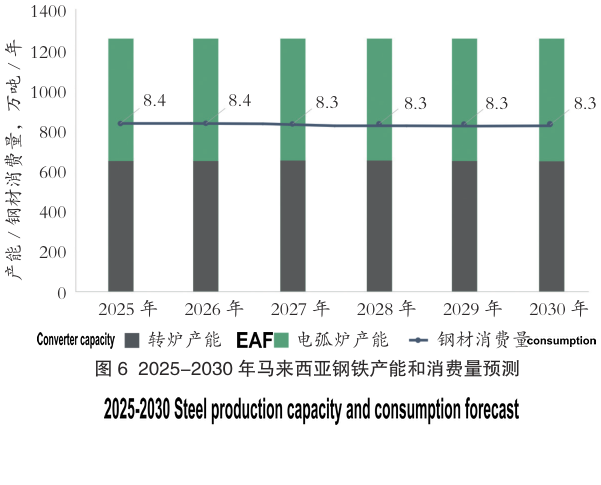
(1) Challenges of Overcapacity and Technological Pathways
The Malaysian steel industry is grappling with overcapacity and stagnant demand, a situation that determines the enthusiasm of steel enterprises for decarbonization initiatives. Most companies are not focused on decarbonization measures but are instead concentrating their efforts on addressing the existential challenges posed by consumption stagnation and global steel overcapacity.
Figure 6, which forecasts Malaysia’s steel production capacity and consumption from 2025 to 2030, indicates that weak steel consumption is expected to persist until 2030. This is due to stable consumption in the construction sector and Malaysia’s continued reliance on imports for higher-grade steel products. Currently, Malaysia’s steel consumption is dominated by the construction industry, which heavily utilizes lower-quality, cheaper long steel products. Although there is strong demand for flat steel, domestic production capacity in Malaysia is limited. With domestic demand saturated, approximately half of the long steel products are exported overseas.


It is unlikely that the new Greenfield steel mill will enter the market before 2030, although its establishment could help avoid further overcapacity. In addition, BF-BOF (blast furnace–basic oxygen furnace) steel mill projects with a combined annual capacity of nearly 12 million tonnes have been announced to have commenced construction. Notably, the Hebei Xinwuan Iron and Steel plant in Malaysia, with an annual capacity of 10 million tonnes, is the largest steel project in the country to date. However, the project has faced repeated delays and, coupled with a sluggish market, remains stuck at the land leveling stage for an initial capacity of 5 million tonnes per year.
In addressing overcapacity and weaker-than-expected consumption growth, Malaysia has limited levers to drive decarbonization. Although DRI (direct reduced iron)-related processes are attractive, their practical application may still take considerable time without policy and financial support.
By 2030, carbon emissions from Malaysia’s steel industry are expected to plateau, reflecting extremely limited investment in new technologies that could effectively improve efficiency or reduce emissions. While energy efficiency technologies are being promoted in the Malaysian market, their overall impact on emission reductions is limited. Large-scale BF-BOF energy efficiency measures mainly focus on the internal utilization of coke and gas within integrated long-process mills, typically promising emission reductions of around 2% to 5%. The BF-BOF process is already one of the most energy-efficient industrial processes globally, operating close to its theoretical energy consumption limits. As a result, there is very limited room for further efficiency improvements or emissions reductions.
(2) Challenges from the External Environment
Escalation of Steel Trade Frictions in Malaysia:
As the scale of steel imports and exports has expanded, Malaysia has become increasingly entangled in global steel trade disputes. Since 2018, Malaysia has initiated over ten anti-dumping cases against multiple countries, covering products such as cold-rolled steel, rebar, and wire rods, with tariff rates as high as 30%. This underscores its determination to strengthen the protection of the domestic steel industry.
At the same time, countries such as Canada, the United States, Australia, and Vietnam have also repeatedly launched anti-dumping investigations into Malaysian products. The affected items include welded pipes, concrete reinforcing bars, and hot-rolled coil, with tariff rates mostly ranging between 10% and 25%. Malaysia is now facing dual pressures of “export restrictions” and “import defenses,” making the trade environment increasingly complex.

9. Policy environment

The Malaysian government has implemented multiple policies to support the development of the steel industry:
(1) ​​The Malaysia Steel Industry Blueprint (2021–2030)​​ emphasizes enhancing value-added production, green manufacturing, and industrial integration. Its goals include increasing the self-sufficiency rate to over 80% and driving the industry toward higher-value transformation.
(2) ​​Trade protection measures​​, such as anti-dumping duties and import licensing, are used to safeguard domestic enterprises. However, these measures also face constraints under WTO rules and regional trade agreements.
(3) ​​Environmental protection and carbon reduction​​: In line with the ​​Paris Agreement​​, the government is pushing steel companies to lower carbon emissions by encouraging the use of scrap steel and renewable energy, along with offering tax incentives. The ​​2050 Carbon Neutrality Goal​​ announced in 2021 further reinforces this policy direction.
(4) ​​Foreign investment policy​​: The government encourages foreign investment in high-end technology and export-oriented projects, though it imposes equity restrictions in certain sectors. The ​​National Investment Aspirations 2030​​ aims to attract high-quality investments to drive industrial upgrading.

马来钢铁.jpg