Every healthcare provider—whether a small clinic or a large hospital system—knows that great clinical care is only half the story. Without an efficient Revenue Cycle Management process, even the most dedicated clinicians can struggle to sustain operations, let alone grow their practice. Health systems around the world are doubling down on digital transformation, and Revenue Cycle Management (RCM) has emerged as the single most impactful lever for improving billing accuracy, maximizing reimbursements, and enhancing patient financial experience.
If you’ve ever wondered why some practices thrive while others struggle with cash flow, delayed payments, and claim denials, this post will dive into the what, why, and how of RCM—backed by real-world insights, data, and practical steps you can take today.
What Is Revenue Cycle Management (RCM)?
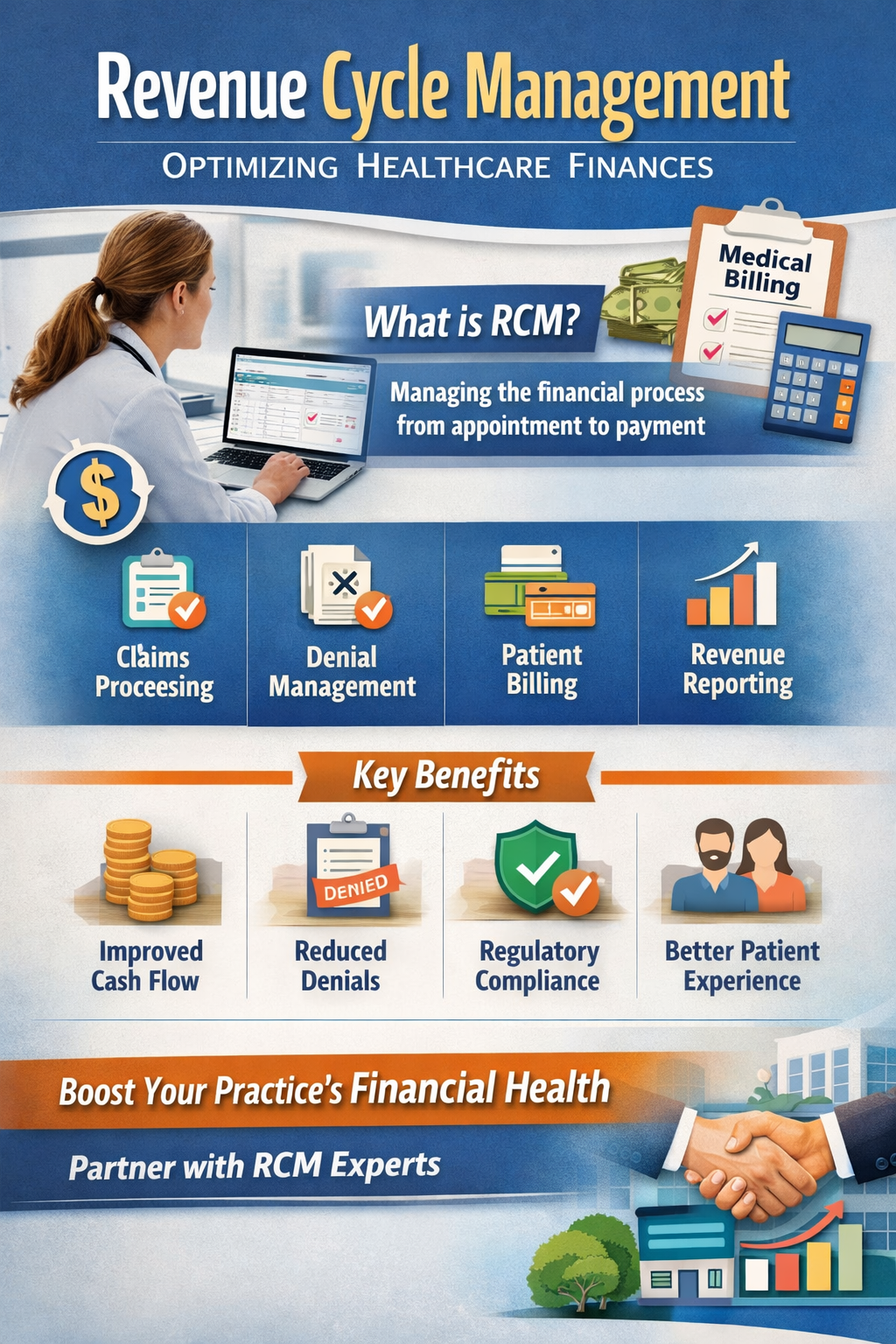
At its core, Revenue Cycle Management is the complete business process that tracks revenue from the moment a patient schedules an appointment to the final payment of the balance. It includes patient registration, insurance eligibility verification, charge capture, claim submission, payment posting, and denial management.
Think of RCM as the financial engine of your practice: when it runs smoothly, your revenue inflow keeps pace with the care you deliver. When it breaks down, money gets stuck in accounts receivable, and operational stress mounts.
Key Activities in RCM
-
Patient registration and insurance verification
-
Accurate medical coding and billing
-
Claim submission to payers
-
Follow-up on unpaid or denied claims
-
Patient billing and collections
-
Analytics and reporting to optimize performance
Why Revenue Cycle Management Matters More in 2026
Over the last decade, healthcare revenue cycle operations have grown more complex due to an explosion in payer types, tighter compliance requirements, and increasing patient financial responsibility. The global RCM market is expected to continue growing significantly, reflecting its critical role in sustainable healthcare operations.
RCM isn’t just about processing bills—it’s about strategic revenue capture and financial stewardship. When optimized, RCM becomes a competitive advantage, not just an administrative function.
5 Major Benefits of Revenue Cycle Management
1. Improved Cash Flow and Revenue Capture
A strong RCM process ensures that providers receive payment promptly and fully for the services they’ve delivered. Effective medical billing services reduce claim denials and accelerate reimbursements, which in turn boosts cash flow.
Many practices that invest in comprehensive RCM services report significantly reduced days in accounts receivable and a more steady cash flow through efficient claims submission and follow-up.
Why it matters: Predictable revenue allows you to invest in new technology, retain skilled staff, and maintain financial stability without compromising care quality.
2. Enhanced Billing Accuracy and Fewer Claim Denials
One of the biggest financial leaks in healthcare is claim denials caused by billing or coding errors, incomplete patient information, or incorrect insurance details. An optimized RCM process minimizes these errors through checks, validations, and compliance expertise.
Accurate claims mean fewer denial cycles, less time spent on appeals, and faster reimbursements—liberating your team from costly administrative bottlenecks.
3. Better Compliance and Risk Mitigation
Healthcare billing is governed by complex, evolving regulations, such as HIPAA and ICD-10 coding standards. RCM services integrate compliance checks at every step to ensure claims are submitted correctly and ethically.
Real-world impact: Practices without robust RCM processes often face penalties or fear audits simply because billing practices lag behind regulatory updates—a risk that effective RCM services help avoid.
4. Stronger Patient Experience
Today’s patients expect transparency around their financial responsibility. Clear, accurate patient billing—supported by RCM automation—helps reduce confusion and surprise bills.
When patients understand their bills and have easy payment options, satisfaction—and loyalty—goes up. Healthcare is personal; RCM ensures the financial side feels human too.
5. Data-Driven Decision Making
RCM systems generate valuable insights—like denial rates, clean claim percentages, and average reimbursement times—that help leadership make strategic decisions.
By tracking key performance indicators, organizations can pinpoint process gaps, forecast financially, and identify which service lines are most profitable.
Personal Story: Why RCM Changed My Practice
When I first stepped into operations at a mid-sized clinic, we were constantly chasing unpaid claims. Providers were frustrated. Patients were confused. And months slipped by before we even realized that much of our revenue was getting “stuck” in the billing cycle.
That’s when we partnered with a professional RCM services provider. Within six months:
-
Denial rates dropped by over 30%
-
Days in accounts receivable reduced by 15
-
Patient satisfaction scores improved
-
Staff were freed up to focus on patient care
It was transformative—not just financially but culturally. RCM wasn’t a back-office function anymore; it was the backbone of our practice.
Medical Billing Services: The RCM Advantage
Outsourcing medical billing services as part of your broader RCM approach means leveraging specialized expertise in coding, payer rules, and healthcare regulations. This expertise typically results in:
-
Faster claim turnaround
-
Higher clean claim rates
-
Better patient communication
-
Lower administrative costs
By tapping into best-in-class systems and talent, practices gain scalability and resilience without ballooning overhead.
Choosing the Right RCM Services Provider
Not all Revenue Cycle Management partners are created equal. Here’s what to look for in a provider:
-
Expertise Across the Entire Revenue Cycle – From registration to collections, your RCM partner should handle every milestone with precision.
-
Transparency in Reporting – You should have visibility into all financial metrics, denial trends, and performance benchmarks.
-
Compliance and Regulatory Support – Choose a provider that stays current with coding changes and payer policies.
-
Patient-Centric Billing Approach – Your RCM partner should boost patient satisfaction, not just financial metrics.
-
Scalable Technology and Workflow Integration – Look for services that can grow with your practice and seamlessly integrate with your existing systems.
Our team at Prospect Healthcare Solutions offers expertly tailored RCM services and medical billing support designed to fit practices of all sizes.
What to Expect When You Implement RCM Services
When healthcare organizations invest in professional RCM services:
-
Standardized billing workflows are implemented
-
Staff are trained on coding and documentation best practices
-
Automated claim scrubbing and error detection are enabled
-
Ongoing reporting and denial management strategies are applied
-
Continuous process improvement is based on performance data
The result? Higher reimbursement rates, fewer administrative headaches, and greater financial clarity.
The Future of Revenue Cycle Management
The healthcare landscape is evolving rapidly. Emerging trends that will shape RCM include:
-
Artificial intelligence and automation for predictive analytics and denial prevention
-
Advanced integration between electronic health records and billing systems
-
Patient-centered financial tools that increase transparency and convenience
As technology advances and regulatory environments shift, practices that lean into RCM services will thrive while others grapple with rising costs and shrinking margins.
Conclusion: Your Next Steps for Revenue Excellence
Revenue Cycle Management isn’t a luxury—it’s a strategic necessity. By embracing robust RCM processes and partnering with experienced medical billing professionals, healthcare organizations can:
-
Strengthen revenue capture and financial stability
-
Reduce claim denials and administrative burden
-
Enhance compliance and reduce risk
-
Improve patient financial experience
-
Leverage data for smarter decisions
If your practice is ready to shift from reactionary billing processes to proactive financial management, now’s the time to explore expert RCM services and medical billing services.
Visit Prospect Healthcare Solutions to discover how tailored Revenue Cycle Management and medical billing solutions can unlock your practice’s full financial potential.